Last updated: October 24, 2026
Key Takeaways
- A hoop is the easiest portable option for small-to-medium projects.
- An embroidery hoop is light, familiar, and easy to pause and resume.
- A frame keeps fabric flatter for longer; a scroll frame is the classic version.
- A hoop prioritizes portability, a frame prioritizes tension, and no support prioritizes freedom.
The right needlework support system depends on three things: how much tension your fabric needs, how long you plan to sit with the piece, and how portable the project has to be. For most embroidery and cross-stitch-style work, a hoop is the simplest default; a frame wins when even tension matters more than quick setup; no support only makes sense for short, casual stitching or fabric that behaves well in hand. For the topic of hoop vs frame vs no support: which setup works for your project, the best choice is usually the one that matches the cloth, the stitch, and the session length.
I write about handwork tools and finishing methods, so I look at these choices the way a stitcher does: by how they affect tension, comfort, and how easily the project moves from couch to bag to worktable.
The short answer: pick the setup that matches the stitch, not the trend

A hoop wins for most small-to-medium projects because it is cheap to move around, easy to swap between pieces, and simple to hold in one hand. A frame wins when the fabric must stay evenly tensioned for many sessions, especially on larger or more detailed work. No support wins only when the project is tiny, the stitch count is low, or you dislike clamping your fabric at all.
That is the decision in plain English. The common mistake is treating these as interchangeable, so it is worth checking the project with a professional or an experienced needlework seller before you buy. They are not. An embroidery hoop grips fabric from the outside with two rings; a scroll frame keeps fabric stretched on rods; a Q-Snap frame uses plastic pipes and corner joints to clamp the edges. Each one changes how the cloth sits under the needle, how often you need to adjust it, and how much hand fatigue shows up after 20 or 30 minutes.
The key trade-off is tension versus convenience. A hoop gives quick control with minimal hardware. A frame gives steadier tension over a larger working area. No support gives maximum freedom, but the fabric can loosen, distort, or get handled more roughly if you are not careful.
If the project lives in a tote bag or moves between rooms, the hoop is usually the most practical first pick. If the project stays parked on a chair for weeks, a frame is easier on the work.
Embroidery hoop: the best all-around choice for portability
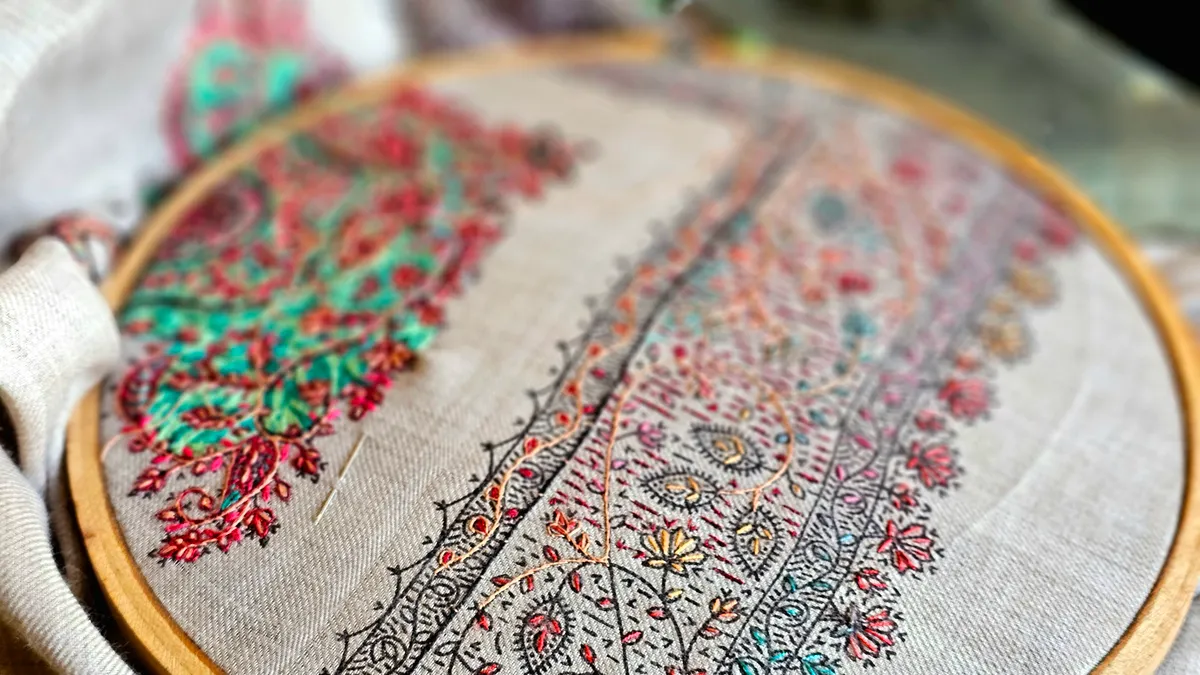
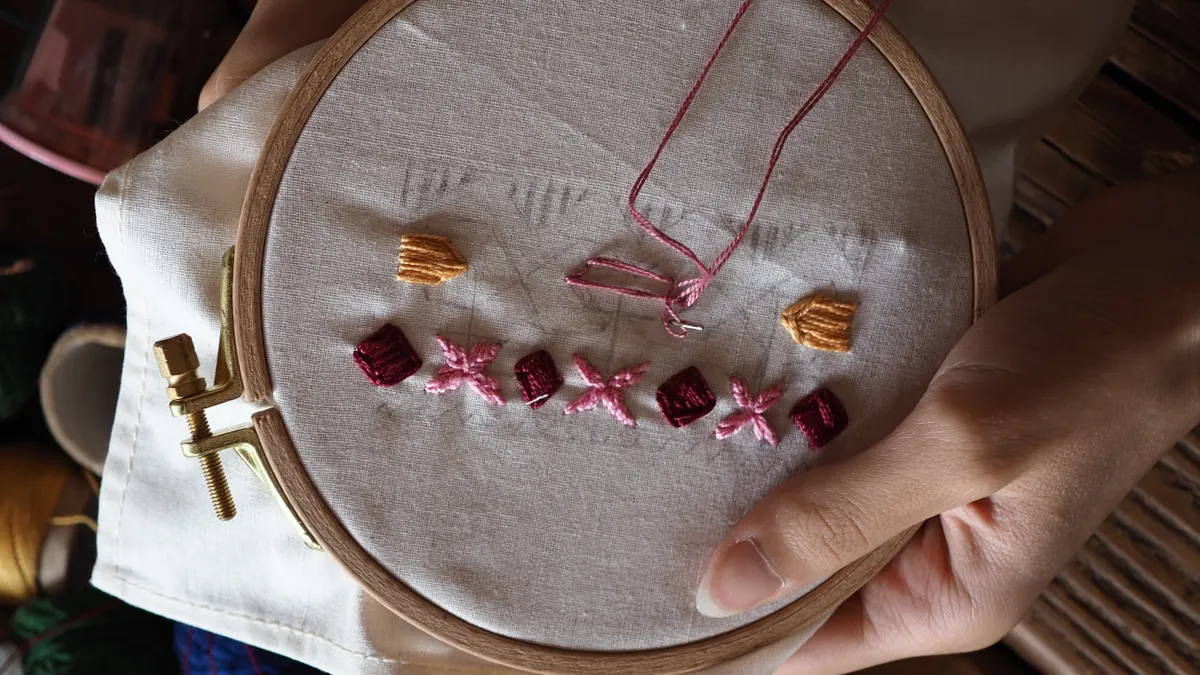
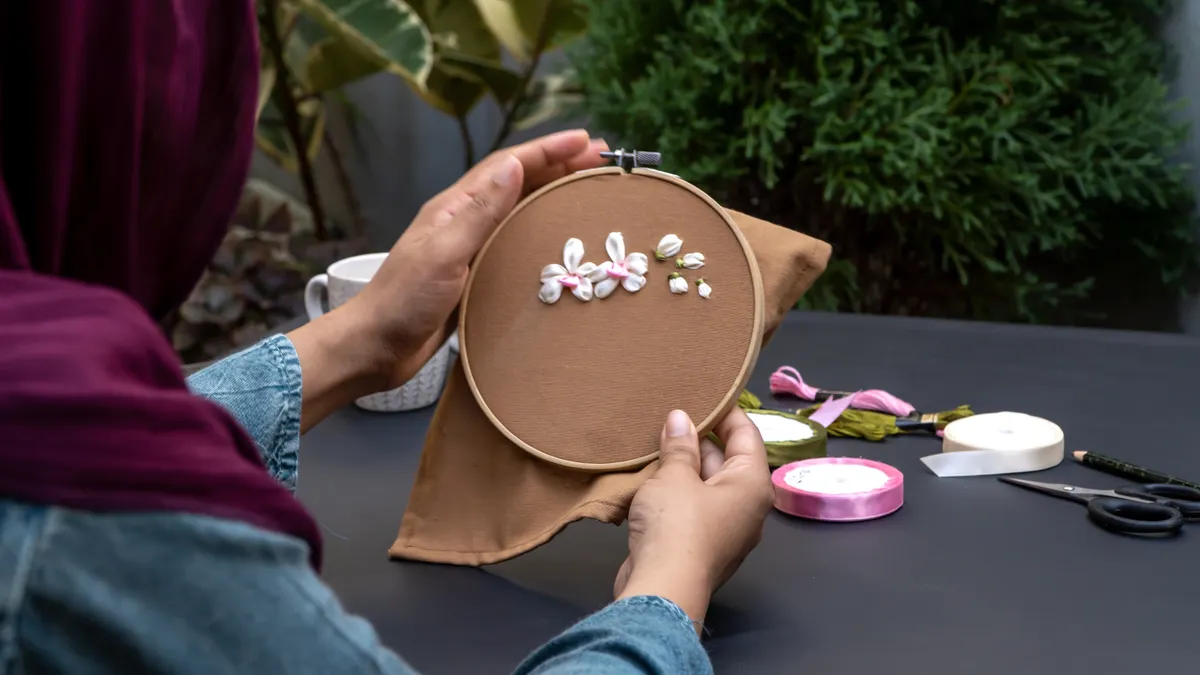
An embroidery hoop is a practical portable choice for handwork because it is light, familiar, and easy to set down for five minutes without dismantling anything. Standard hoops come in common sizes such as 4, 6, 8, and 10 inches, and those sizes match the reality of most small motifs better than a full frame does. A 6-inch or 8-inch hoop is usually enough space for a motif, border, or small sampler section without forcing the whole project into one rigid setup.
The main strength of a hoop is that it solves the “I want to stitch anywhere” problem. It fits in a project bag, works on a sofa, and is simple to reposition as you move across the design. It also keeps the fabric more controlled than stitching completely freehand, which helps when the ground fabric tends to wrinkle or when your stitch line needs a clean edge.
The weakness is equally clear: a hoop only controls the area inside it, and tension can shift as you move the hoop. That means the fabric outside the ring may bunch, and if you leave the same spot clamped too long, some materials can show a crease line. A hoop also gives you less real estate for larger designs, so a project that spans a wide area becomes a cycle of unclamp, shift, and reclamp.
A hoop is the right choice if the project is small, you stitch in short sessions, or the work needs to travel. It is not the best choice if you are doing a large counted piece and want the fabric to stay uniformly taut from edge to edge.
If you are comparing tools for a beginner-friendly path, the hoop is the setup that fits the same kind of practical advice that belongs in a needlework for beginners guide: simple, cheap, and easy to put away.
Scroll frame and Q-Snap: when steady tension matters more than speed
A frame is the answer when the stitch surface has to stay flatter for longer, and a scroll frame is the classic answer for that problem. It keeps the stitched area rolled out of the way while the working area stays under tension. That matters on larger samplers, dense filling stitches, counted thread work, and projects that punish loose fabric. If the cloth moving around the needle is the thing slowing you down, a frame removes part of that friction.
A Q-Snap frame sits in the middle. It is lighter and more modular than a wooden scroll frame, and the clamp-on edges make it appealing for medium projects that need more control than a hoop can provide. It is often favored by stitchers who want a rectangular working window instead of a round one. That shape is useful when a design is long, narrow, or charted in rows.
The benefit of both frame styles is steadier tension over a wider surface. That can reduce the need to re-tighten every few minutes and can make stitches land more consistently, especially where neat spacing matters. The downside is obvious once you try to travel with one in a small bag: frames are bulkier, less spontaneous, and slower to set up. A scroll frame can also be overkill for a tiny motif, and a Q-Snap can feel awkward if you like to turn the work often.
A frame is the better choice if your project is large, if the fabric needs to stay evenly tensioned across a broad area, or if you get annoyed by constantly readjusting a hoop. It is not the best choice if you want to stitch on a commute, tuck the work beside the sofa, or switch between several small pieces in one evening.
The honest side-by-side
A hoop is the portability winner, a frame is the tension winner, and no support is the freedom winner. The right call depends on which of those matters most on this specific project.
| Criteria | Embroidery hoop | Scroll frame / Q-Snap | Winner for this condition |
|---|---|---|---|
| Fabric tension | Good for small areas | Better across a larger surface | Frame for long sessions |
| Project portability | Very easy to carry | Bulkier and less packable | Hoop for travel |
| Setup time | Fast | Slower | Hoop for quick starts |
| Surface control | Round working window | Wider or rectangular window | Frame for larger designs |
| Hand comfort | Light, simple grip | Often easier for long holds if mounted well | Frame for long sessions |
| Risk of re-clamping marks | Higher if left in one spot | Lower over a rolled or clamped span | Frame for delicate fabric |
| Best for small motifs | Yes | Often more than you need | Hoop |
| Best for large counted work | Limited | Strong fit | Frame |
| Works without extra hardware | Yes | No | No support for true minimalism |
No support only looks like a third equal option until you compare what it actually costs you in control. It is the easiest setup to start with, but it gives up the most tension management. That is fine for casual, low-stakes stitching. It is a poor fit for designs where a slight fabric shift throws off symmetry, spacing, or finishing.
The rule of thumb is straightforward: if the fabric can be held comfortably in hand for the whole session, no support can work. If the cloth starts to wander, pucker, or tire your fingers, move to a hoop. If the work still fights you after that, a frame is the next step.
No support: the right call for some projects, and the wrong one for many
No support wins when the project is tiny, the stitches are sparse, or the fabric itself is cooperative. That includes quick mending, tiny decorative details, some freeform embroidery, and pieces where the shape of the fabric matters more than perfectly even tension. It also suits stitchers who dislike any ring or clamp around the work and prefer to keep the fabric loose in the hand.
The upside is obvious: zero hardware, zero setup, and full freedom to rotate the fabric as needed. There is no hoop edge to shadow the view and no frame to move out of the way. For small, fast work, that simplicity matters.
The drawback is not subtle. Without support, the fabric can shift under repeated stitches, especially on slippery or loosely woven cloth. Your non-dominant hand ends up doing more management work, which can slow the process and increase strain. It is also easier to distort a pattern if you pull unevenly. That is a real problem on counted designs where even stitch spacing matters.
No support is the right choice if you value speed and flexibility over precision, or if the piece is small enough that the cloth stays stable in your hands. It is the wrong choice if you are doing a larger embroidery, a design with long straight lines, or anything that needs steady tension across several inches.
What changes the choice more than the product itself
The biggest variable is not the tool name; it is the project. A 3-inch motif on linen does not need the same support as a full sampler on a 12-inch stretch of fabric. Hoop sizes matter because they define how much of the piece you can hold under control at once. If the design area is wider than the hoop, you will be shifting it repeatedly. That is manageable on a tiny motif and irritating on a larger one.
The other variable is how long you plan to sit with it. Short sessions favor convenience. Longer sessions favor steadier tension. If you stitch for 15-minute bursts, a hoop or no support can be enough. If you stitch for an hour at a time, hand strain and fabric drift become more important, and a frame starts to earn its keep.
Holding method also matters. A hoop can be held in the hand, propped on a stand, or set down between sessions. A frame often pairs better with a stand or lap support if the project is large. That changes comfort more than people expect, especially for shoulders and wrists.
For readers building skills, the practical path is simple: start with the least complicated setup that still keeps the fabric behaving. If the work starts to look sloppy or feels tiring, move up one level before you overcorrect.
The verdict: which one to choose and why
Choose a hoop if your project is small to medium, you want the easiest portable setup, and you are stitching in short sessions. Choose a frame if the piece is large, tension-sensitive, or likely to stay on the same project for weeks. Neither if the work is so small and casual that hand-holding the fabric is easier than any device.
That is the cleanest recommendation. A hoop is the best default for many people because it balances control and portability without much fuss. A frame is better for the projects that punish slack fabric. No support is a niche choice, not a universal shortcut.
The wrong buyer for a hoop is the person doing a large, tension-critical project and hoping a 6-inch ring will behave like a scroll frame. The wrong buyer for a frame is the stitcher who wants to toss the piece into a bag and work anywhere. The wrong buyer for no support is anyone working on a design where even tension and clean geometry matter.
When the choice flips
A frame beats a hoop if the fabric is wide, slippery, or needs to stay evenly stretched for more than a few sessions. A hoop beats a frame if you move around often, stitch in short bursts, or hate bulky tools. No support beats both only when the piece is small enough that your hands can manage the cloth without strain.
There are a few exception scenarios where the general verdict changes. First, very stiff fabric can make no support surprisingly workable, because the cloth holds itself better than softer weaves do. Second, a very large hoop can cover a project that would otherwise force repeated repositioning, though the size can become awkward to hold. Third, a Q-Snap can feel like the sweet spot for someone who wants rectangle-shaped tension without the bulk of a traditional scroll frame. Fourth, if a project must fit into a small travel bag, portability can outweigh perfect tension.
That is why the “best” support system is not a single object. It is the setup that matches the project’s size, the way the cloth behaves, and how you actually sit down to stitch. For more on choosing tools in the same practical way, the hub on needlework for beginners covers the broader first steps.
Do I need a hoop for embroidery?
No, you do not need a hoop for every embroidery project. A hoop helps keep fabric steadier, but small or stiff pieces can be stitched without one if the cloth stays manageable in hand. If the fabric puckers, shifts, or tires your fingers, a hoop usually makes the work easier and more even.
What is better, a hoop or a frame?
A frame is better for long sessions and larger, tension-sensitive work, while a hoop is better for portability and quick setup. The better choice depends on the project size and how much control the fabric needs. A 6-inch hoop is fine for many small motifs; a scroll frame or Q-Snap suits broader designs.
Can I embroider without a hoop?
Yes, you can embroider without a hoop if the project is small enough and the fabric stays stable in your hands. That works best for quick details, simple embellishment, and stiff cloth. It is a weaker choice for larger designs, counted work, or any piece where consistent tension is part of the finish.
Drafted with AI; not yet reviewed by a person.