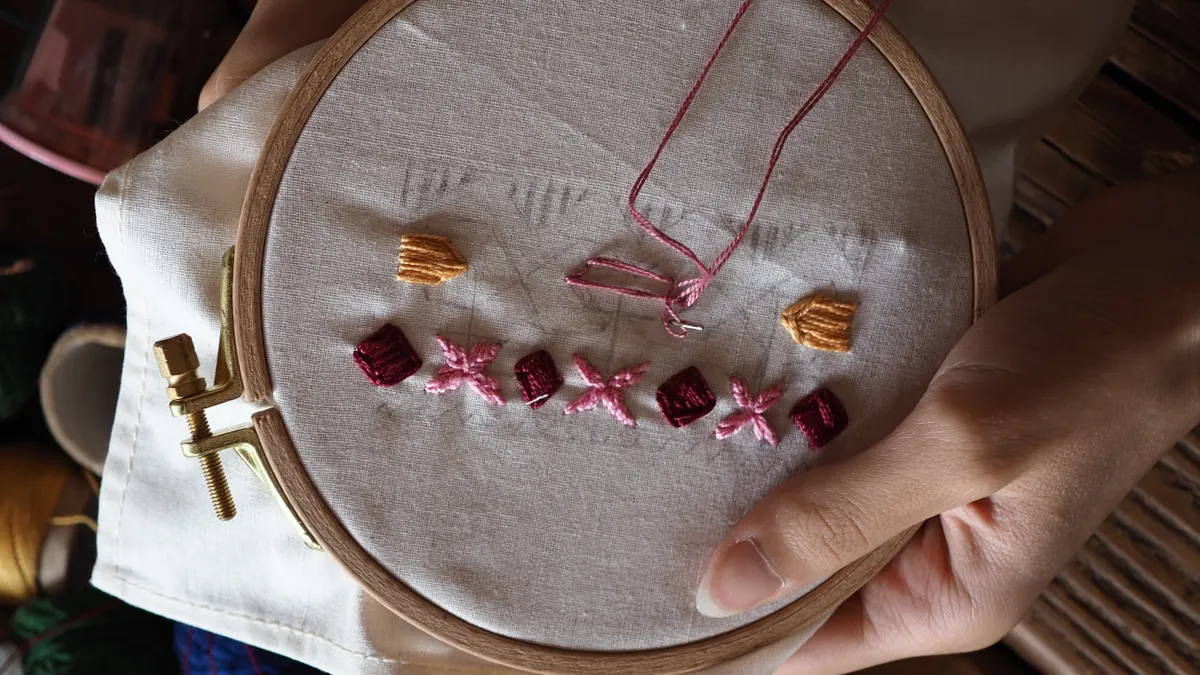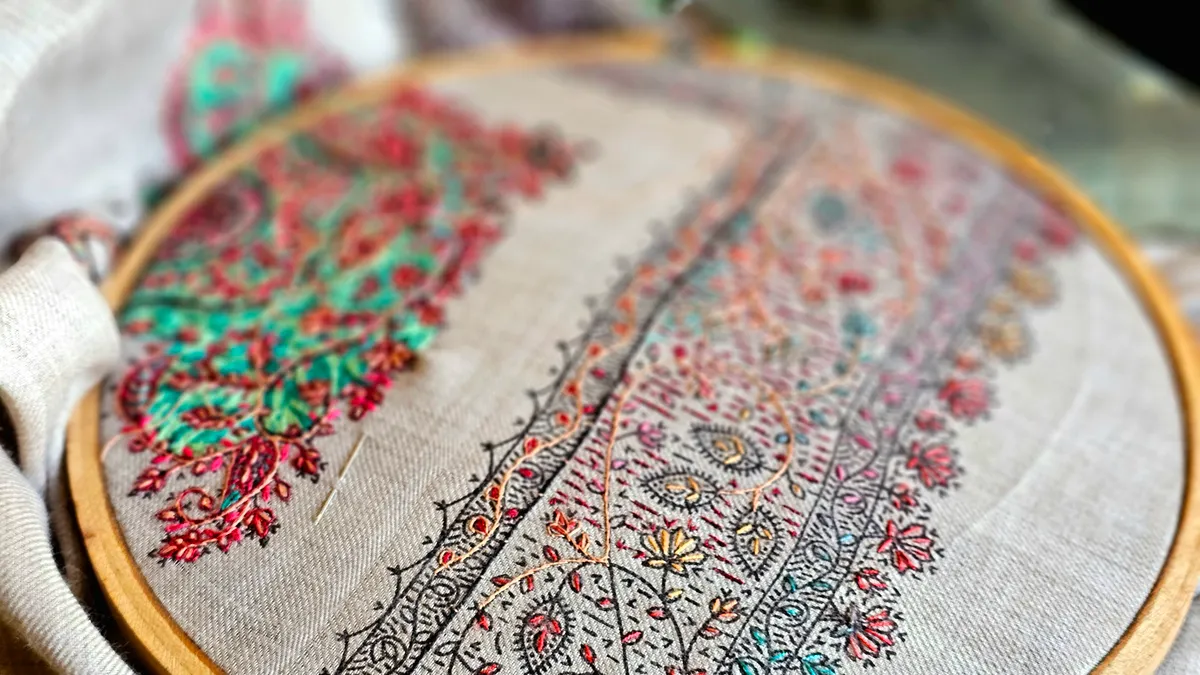
Last updated: October 22, 2026
Quick Answer: choose embroidery floss, perle cotton, or yarn based on stitch size and fabric count, not brand name. If you want one fast rule for Embroidery floss vs perle cotton vs yarn: what to use and when, floss suits small detailed work, perle cotton suits visible raised stitches, and yarn suits coarse fabric and oversized texture.
Embroidery floss, perle cotton, and yarn are not interchangeable; the right one depends on the stitch, the fabric, and the surface effect you want. I write needlework content for readers who want the practical answer fast, and Embroidery floss vs perle cotton vs yarn: what to use and when is for the person staring at three spools and asking, “Which thread should I actually use?”
If the goal is clean coverage on small stitches, embroidery floss often works best. If the goal is a raised, rope-like line with visible twist, perle cotton usually wins. If the goal is bold texture on coarse fabric, yarn can be the right tool, but it is easy to overdo.
Key takeaways
- Embroidery floss is the most flexible choice because you can separate it into strands and adjust thickness.
- Perle cotton is a twisted, non-divisible thread that gives a rounder, shinier line.
- Yarn is much thicker and belongs on coarse fabric, chunky surface work, or very large stitches.
- Stitch type matters more than the label on the skein.
- Cotton, silk, and blended fibers change sheen, drag, and durability.
- If the fabric weave is fine, yarn is usually the wrong choice.
What changes the result: strand count, weight, and surface effect
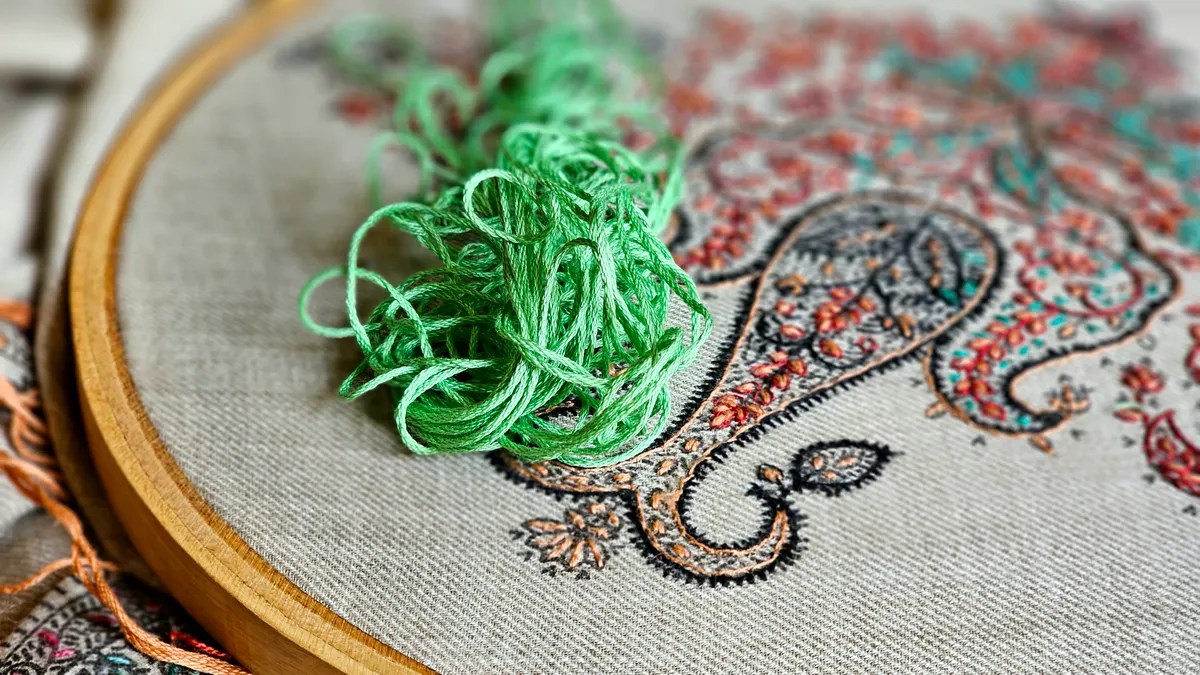
The real decision is not just material name; it is thickness, twist, and how much of the fabric you want to cover. A 6-strand embroidery floss can be used as 1 strand, 2 strands, or all 6, which makes it the most adjustable option. Perle cotton comes in fixed sizes and is not meant to be separated. Yarn is thicker still and is usually sold by weight or gauge rather than by strand count.
That difference changes the finish. Floss lays flatter and is easier to control on detail work. Perle cotton stands up off the fabric more, so lines read stronger and stitches look more defined. Yarn gives the biggest texture and fills space quickly, but it can swamp small motifs and make fine stitching look clumsy.
For beginners, the key is matching coverage to fabric. A smooth surface on linen or evenweave needs a thinner thread. A visible, tactile surface on canvas or wool may need something thicker. The Needlework for Beginners hub should sit alongside this page because the first real decision is still fabric plus thread, not thread in isolation.
Two useful reference points help here: embroidery floss is commonly sold as divisible 6-strand cotton, while perle cotton is usually labeled by size, such as No. 3, No. 5, or No. 8, with lower numbers generally meaning thicker thread. Yarn is often described by craft-weight systems such as lace, fingering, worsted, or bulky. That naming difference matters because it tells you how much surface the thread will cover before you even make a stitch.
For a broader technical frame, the DMC and Schachenmayr-style labeling systems are built around thread construction, while fiber standards and care guidance are often discussed by textile groups such as The National NeedleArts Association and the American Sewing Guild. See also the embroidery floss guide, perle cotton guide, and yarn weight chart for more on sizing and thread labels.
Embroidery floss: the most flexible choice for detailed stitching
Embroidery floss wins for detail, blending, and control. It is the right pick when the same skein needs to behave like three different threads on three different projects. Because it is divisible, it can cover tiny lettering, small floral motifs, and satin stitch without forcing the fabric into a heavy, bulky look.
That flexibility is the reason floss is still the default for many surface-embroidery projects. You can use a single strand for delicate linework, 2 strands for moderate coverage, or the full bundle for bolder fills. The same skein works across multiple stitch types, which makes it efficient for samplers and mixed-design pieces.
The drawback is also the reason some people dislike it: divisible floss can separate, shred, or fuzz if you pull too hard or work with overly long lengths. The strands can also twist on themselves, which makes a smooth stitch harder to maintain. If you want a consistently round, raised line, floss can look too flat unless you build up several strands.
Embroidery floss is not always the best choice for someone who wants immediate, bold coverage with minimal adjustment. It also is not ideal when the fabric is very open and the stitch needs to sit visibly on top instead of sinking into the weave. On coarse canvas or burlap, floss can look underpowered unless you use many strands.
Choose embroidery floss if you want one thread that can do multiple jobs: outlining, filling, shading, monograms, and counted work. Skip it if you want a chunky decorative line with obvious twist or if you dislike splitting strands before every project.
Perle cotton: the cleaner choice for bold, rounded stitches
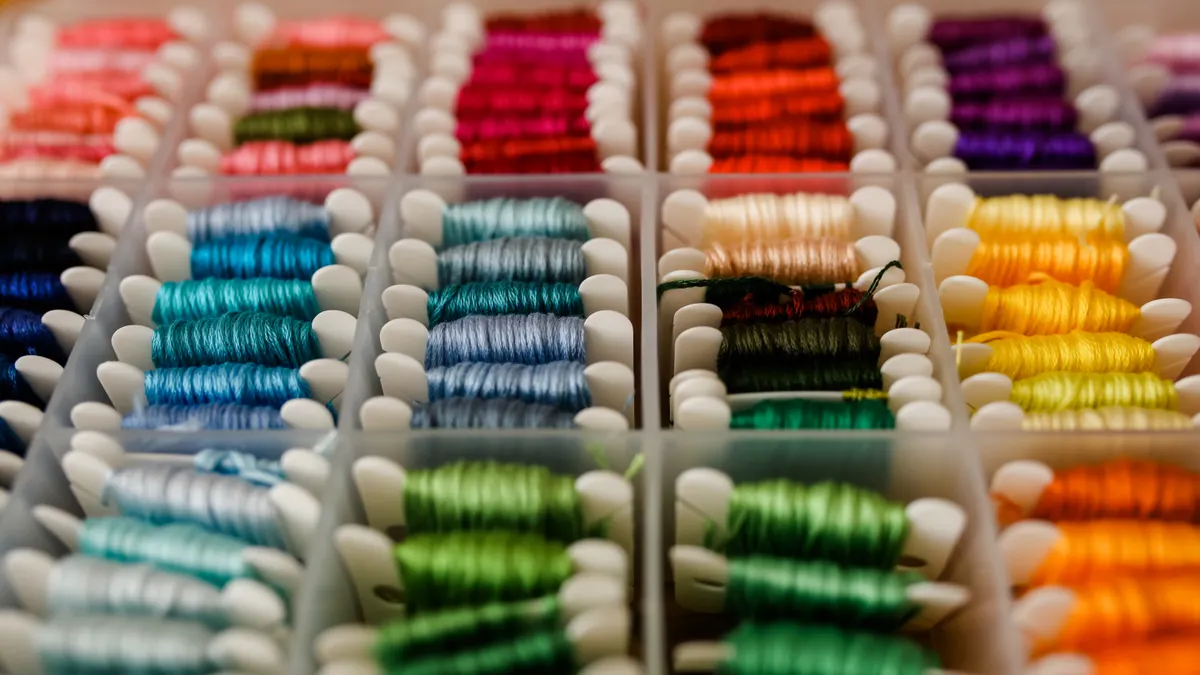
Perle cotton wins when the stitch itself should be the surface feature. It is the thread I would choose for people who want a fuller line without having to separate strands, because the twist is part of the appeal. The result is rounder and more dimensional than standard floss, and the finish often reads neater on decorative stitching.
Its biggest strength is consistency. Since perle cotton is not divisible, the stitch thickness stays stable from the first pass to the last. That makes it especially useful for stem stitch, chain stitch, blanket stitch, French knots, and other stitches where body matters. The visible twist also adds texture without requiring extra strands.
Because that stitch thickness stays stable, perle cotton is less adaptable than floss. You cannot thin it down by pulling off one strand, and that means you have to choose the size more carefully before starting. If you want whisper-thin outlines, it is too heavy. If you want to shade a tiny motif with subtle transitions, it can be too blunt.
Perle cotton is usually sold in sizes such as No. 3, No. 5, and No. 8, with the smaller number being thicker in the common numbering system. That makes it a better fit for medium or larger stitching where the line should stay visible from a short distance. It also pairs well with fabric that can support a more substantial thread, such as cottons with a firmer weave or canvas intended for decorative stitches.
Who should skip it? Anyone doing very fine counted embroidery, tiny lettering, or projects where the thread needs to disappear into the fabric rather than announce itself. It can also frustrate stitchers who want to improvise thickness as they go.
Is yarn ever the right choice for embroidery?
Yes, yarn is the right choice when the fabric is large enough for it and the design is meant to be textural rather than delicate. Yarn belongs in the “make it bold” category, not the “make it precise” category. Think chunky decorative stitching, woven accents, large surface fills, and projects on coarse grounds where a thread-sized line would vanish.
Yarn wins on visual impact. It covers space quickly and creates strong texture in a way that floss and perle cotton cannot match. On wool, canvas, burlap, needlepoint canvas, or open-weave textiles, yarn can produce a plush, graphic look that feels deliberate rather than oversized.
The drawback is scale. Yarn can make a fine embroidery design look clunky fast. It can crowd small motifs, obscure detail, and create tension issues if the fabric is too delicate; if that is a risk, consult a professional or test on a scrap first. It also tends to demand larger needles and more open stitching paths, which pushes the project away from conventional embroidery and closer to textile embellishment or fiber art. The American Sewing Guild and The National NeedleArts Association both emphasize matching thread size to fabric stability.
A simple rule helps: if the fabric count is fine enough that you would normally think in single strands, yarn is probably wrong. If the fabric has visible holes or a heavy ground, yarn may be exactly right. That is why yarn is a poor match for most delicate hand embroidery, but a strong choice for dramatic decorative work.
Yarn is not the answer for precision outline work, monograms, small flowers, or any project where the stitch is supposed to lie flat and sharp. It is also a bad idea if you want to follow a pattern written for stranded floss or perle cotton, because the coverage will change the design proportions.
The honest side-by-side
Embroidery floss wins on versatility. Perle cotton wins on definition. Yarn wins on scale. That is the cleanest way to choose.
| Criteria | Embroidery floss | Perle cotton | Winner for [condition] |
|---|---|---|---|
| Thickness control | Divisible into strands, so thickness is adjustable | Fixed size, no strand splitting | Floss for mixed-detail projects |
| Surface finish | Flatter, softer look | Rounder, more textured line | Perle cotton for visible stitches |
| Fine detail | Strong choice for small motifs | Can look too heavy | Floss for tiny work |
| Bold decorative line | Can be built up, but takes more planning | Naturally bold and even | Perle cotton for outlines and accents |
| Large coverage | Efficient only when multiple strands are used | Good medium coverage | Perle cotton for medium fills |
| Coarse fabric | Can feel underpowered | Usually a better fit | Perle cotton for firmer grounds |
| Very coarse or bulky work | Too light for most uses | Still may be too small | Yarn for chunky texture |
| Ease of matching a pattern | Common in instruction sheets and charts | Common in decorative embroidery | Floss for flexible pattern use |
| Risk of overthickness | Moderate if too many strands are used | Higher if the size is too large | Floss for restrained coverage |
The main lesson is simple: floss gives you control, perle gives you presence, and yarn gives you volume. If you are trying to choose once and buy one thing, floss is often the safest starter option because it can imitate a narrower range of effects. If you already know you want a raised line and don’t want to split threads, perle cotton is the more efficient choice. If you want texture first and detail second, yarn is the one that belongs on the table.
Which one should I buy for my project?
Choose embroidery floss if you want one supply that handles most beginner embroidery tasks and lets you change strand count as needed. Choose perle cotton if you want a stronger, rounder stitch line and you are working on a project where the thread should show. Choose yarn only if your fabric is coarse enough to support it and the design is meant to look thick, bold, or tactile.
That recommendation changes when the stitch type changes. Satin stitch, split stitch, stem stitch, chain stitch, and French knots each respond differently to thickness. Floss is the most adaptable across that group. Perle cotton gives a cleaner look in raised decorative stitches. Yarn is usually the outlier, useful for oversized or experimental work rather than standard embroidery.
If the project calls for silk thread, expect a different feel entirely. Silk usually brings more sheen and a smoother glide than cotton, but it is a separate decision from this comparison and is often chosen for luxury finish rather than convenience. Cotton thread, by contrast, usually means a practical, matte, workhorse option, which is why it is so common in beginner kits and general embroidery supply lists.
For a beginner, the safest default is often embroidery floss in a midrange fabric count and a small number of strands. For a decorative pillow, hoop art, or textured sampler, perle cotton often gives a better payoff with less fiddling. For textile art on coarse ground, yarn can be the point of the piece.
When to reconsider the choice entirely
Sometimes the right answer is not “which thread,” but “is this the right technique for the fabric?” That is especially true when the fabric weave is too fine for yarn, too loose for small floss stitches, or too unstable for a heavy decorative line. In those cases, changing the thread will not fix the problem; changing the method will.
Reconsider your choice if the pattern depends on tiny details. A thread with too much body can blur edges, hide stitch definition, and make the motif lose proportion. Reconsider it if the fabric puckers with just a few stitches, because the issue may be thread bulk rather than tension. Reconsider it if the finish you want is flat and graphic, but the thread you picked wants to stand up and shadow the design.
Three exception scenarios flip the usual verdict. If the design is intentionally oversized and textural, yarn can beat both floss and perle cotton. If the stitch needs a crisp, raised outline on a medium weave, perle cotton can beat floss even though it is less flexible. If the design is highly detailed and the fabric is fine, embroidery floss remains a safe choice even when a thicker thread looks more exciting in the skein.
The one thing I would not do is choose by fiber name alone. Cotton, silk, and blended threads can all behave differently at the same apparent thickness. The project, the stitch, and the cloth decide the winner.
The verdict: choose the one that matches the stitch, not the shelf label
Choose embroidery floss if you need one thread that can shift from delicate to medium coverage by changing strand count. Choose perle cotton if you want a fixed, round, decorative thread that gives stitches more definition and body. Neither if your fabric is too fine for yarn or your design depends on detail that a thicker thread will bury.
Can I use yarn for embroidery?
Yes, but only when the fabric and design are built for it. Yarn works best on coarse grounds, larger stitches, and texture-first projects. It is a poor choice for small motifs, fine linework, or any pattern that expects the thinner, more controllable behavior of floss or perle cotton.
What is the difference between floss and perle cotton?
Embroidery floss is usually divisible into multiple strands, while perle cotton is a twisted thread sold in fixed sizes such as No. 3, No. 5, or No. 8. Floss gives more control over thickness. Perle cotton gives a rounder, more textured finish and is easier to use when you want a bold stitch line.
Which thread is easiest for beginners?
Embroidery floss is usually easiest for beginners because it is the most forgiving and adjustable. You can reduce strand count for small details or add strands for more coverage. Perle cotton can be simpler in projects that want a fixed thickness, but it is less flexible if you need to change the line weight as you go.
Drafted with AI; not yet reviewed by a person.